By J.D. Considine
The first time I saw the Cars, I was tempted to feel sorry for them. It was 1978, and the Cars were opening for Foreigner at the local sports complex.
At the time, It seemed like the Christians opening for the lions. As far as the heavy metal kids were concerned, the only thing worse than disco was punk, and the chances that a smart, new-wavish band from Boston could win the hearts of 14,000 kids waiting to sing along with Hot Blooded" seemed pretty slim.
Little did I know. Despite the band's severely artsy attire, which ranged from spandex leopard-spots and black leather to exaggerated stripe and polka-dot motifs, the kids didn't look at the Cars and decide they were punks. Instead, they listened to the Cars, and decided they liked what they heard. Some of it they simply loved. The two most obvious crowd-pleasers were "Just What I Needed," which, as sung by the band's good-looking bass player, attracted a lot of feminine attention; and "My Best Friend's Girl," a snappy tune served up by the band's rhythm guitarist, a guy awkward and gangly enough to have passed for Elvis Costello's American cousin.
Their rags-to-riches leap from the Boston club scene to arena glory seemed overnight, but actually concealed ten years of dues-paying. After meeting in Cleveland, gangly guitarist Ric Ocasek and heart-throbbing bassist Ben Orr had moved through Detroit and the Big Apple before settling in Boston. One of their first attempts was a folk trio called Milk-wood, which actually released an album in 1972. It didn't do much else, though, and soon afterwards Ocasek and Orr had formed Richard and the Rabbits, which included Marylander Greg Hawkes on keyboards. Unfortunately, the Rabbits died, and Hawkes took off, eventually winding up with Martin Mull's Fabulous Furniture. A few prototypes later, Ocasek and Orr had another hot prospect in Cap'n Swing, which featured Long Islander Elliot Easton on guitar. This, too, failed, but Ocasek and Orr held onto Easton, got Hawkes back and recruited Bostonian David Robinson, who had drummed with protopunks the Modern Lovers as well as punk rockers DMZ, to complete the line-up. The new band was christened the Cars.
As it turned out, the Cars and their self-titled debut album were the hit of that season. The album went platinum, and the band walked off with every Best New Artist award except the Grammy (which, typically, went to a one-shot disco act, Taste of Honey). What was unexpected was that the Cars didn't turn to formula to hold on to their audience. The band moved ahead, and the fans didn't miss a step following them. And ironically enough, Foreigner itself emerged this year with "Urgent," a single that sounds suspiciously like the Cars. Small world, isn't it?
Ric Ocasek is sitting in the basement lounge of the Cars' recently acquired and refurbished Boston studio. Although there are still a few bits of carpentry to be done, the studio is sleek and modern-looking, all pristine white walls, dark wood floors and tasteful austerity. In fact, it looks a bit too new: between the unfinished construction and the unremitting cleanliness, it looks not unlike a model apartment for a new development of Swedish-style condominiums.
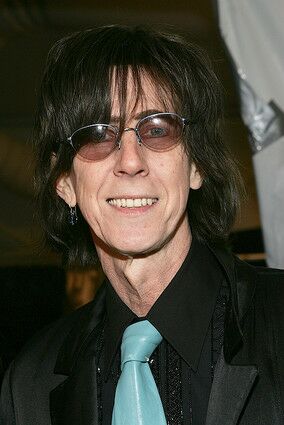
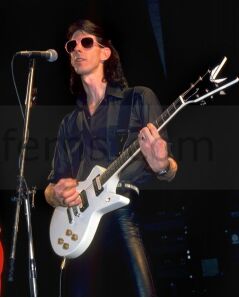
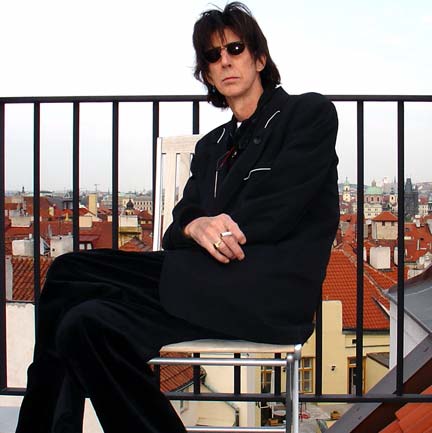
Typically, Ocasek is dressed in black from head to toe. Yet as ultra-modern as his appearance makes him seem, his actions are far less imposing. He's sprawled across a canvas-backed director's chair like an oversized teenager, and he speaks quietly, almost shyly. I mention that while working for a daily paper in Baltimore, Ocasek's hometown, I had received a letter from his father, objecting to a less-than-enthusiastic review of Panorama. Pop Octasek (which is how he spells it) even provided his own headline, "The Cars Run On High Test, Says Father." His son laughs, and says, "He's in Florida now. He goes into record stores and puts the records in front: and all that stuff."
Who knows, even as you read this he may be checking to see that Shake If Up, the Cars' fourth album, is getting the shelf exposure it deserves. I wouldn't worry, though, because the new album is the band's most melodic and accessible. That's about the only similarity between the two, however; Shake If Up isn't so much a return as it is an extension of the ideas explored on The Cars. That first album broke some important ground in applying minimalist rock devices, like the clicking rhythm guitar on "Best Friend's Girl" and "Just What I Needed," to standard pop song forms.
Although the Cars scraped at the limits of the forms on side two of the first album, it wasn't until Candy-O that Ocasek's pop instincts were fully sublimated by the band's modernistic musical vocabulary. This time, instead of being hooked by the simplicity of the rhythm, you were drawn in by the way each bit of melody was wrapped in a new and unexpected sound. Oddly enough, the synthesized soundscape wasn't as off-putting as you'd expect- each weird sound made the music that much more interesting to listen to. A neat trick, but not an easy one to maintain. Panorama, the third album, extended the band's arsenal of acoustic curiosities by lavishing textural detail onto each track, so that every song was awash in burbling guitars and wooshing synthesizers. Unfortunately, this turned out to be a little too modernistic, not because it was unlistenably avant-garde, but because it was so emotionally remote. At times, it sounded like the Cars were playing at us, not to us.
Shake If Up adjusts for that and more. Not only are the melodies back up front, but they haven't been stressed at the expense of the band's textural tapestries. Perhaps more significant, though, is the amazingly personal nature of some of the songs. Although I wouldn't exactly call it confessional, the forthright emotionality of "I'm Not The One" adds a sense of character and emotion that has been sorely lacking in previous Cars albums. Listening to it, I become increasingly curious to see what turns up on Ocasek's solo album, for which Geffen records has contracted.
It'll be a while before we hear that one. The immediate priority on the Cars' schedule is a quickie tour in early '82. In the meantime, Ocasek is indulging in his passion for production . Just upstairs, Ian Taylor, the engineer who assisted Roy Thomas Baker on Panorama and Shake If Up, is working with Romeo Void for an album he and Ocasek are preparing. Right now, though, Ocasek is thinking hard to come up with an answer to the $64,000 question, Why are the Cars so popular? "I really don't know," he says, "I mean, it's obvious we had no idea that we would have sold so many records. But what do I think did it? You know, I can't pin-point it."
Perhaps, Ocasek suggests, the fans accept the Cars, even at the band's most avant-garde, because they can relate to the mood the music expresses. "I think people like things that are different," he says, "if you don't treat everybody like an idiot. People are smart enough.. .I don't think it's very difficult. We're not Joy Division. It's not very difficult to catch on to the Cars "It's pop, basically. It is. I just don't think it's reactionary, like most pop is."
True, the Cars are a pop band, but it's just as true that they're an art band. On the arty side, the Cars are avowed minimalists, but on the pop side, that just works out as keeping the songs uncluttered. "I guess we just filter things out," he says, "and make sure whatever we put in means something, at least to us.
'There are certain things to go for," Ocasek admits. "It's right, it's played well, and it doesn't have things that seem to complicated for someone to learn or pick up. There are things there that are easy to grab onto, and I think that's real important, for the people who are listening to the music to get that." It's that conscious discipline that holds the pop in place. "It could be real Out," Ocasek says of his music. "But I think that's one of the things, the fact that you can remember those lines.
Aside from the music's poppish insistence, the other thing to keep in mind about the Cars is the band's notion of modernity. Most avant-garde bands take their futurist perspective too seriously, and see themselves as alienated from the past and most of the world around them. Although the Cars are no strangers to alienation - how many bands would have sounded as at home singing "Misfit Kid"? - they don't see it as the inescapable by-product of modernism. Instead, the Cars see modernism as a reconciliation between the values of the present, and the possibilities of the future.
To Ocasek's way of thinking, pop for its own sake is reactionary because, "it's a reaction to something that has already been done and embellished upon. Being a musician or a writer or whatever I'm in, I'm always looking for an alternative to what I particularly think is pop. There aren't too many pop bands that I really like
Who, for instance?
'E.L.O.'
E.L O.? Ocasek laughs embarrassedly. "That just came to the top of my head."
Well, it is a ways from minimalism.
'Oh, yeah." he agrees. "E.L.O.'s pretty heavy-duty, everything-and-the-kitchen-sink. But the structure of the songs and the beauty of the melodies is.. Even though they're very Beatlesque, there's hardly one song you could listen to that doesn't have a very heavy hook in it. Every time I hear an ELO. album, I think, 'How'd they do that?' again."
"How'd they do that" is a question that plagues a fair number of Cars fans, too. If writing "things that are easy to grab on to" is the most obvious aspect of the group's pop side, then backing pop with an array of interesting noises is the band's most tangible manifestation of modernism.
"It's funny," says keyboardist Greg Hawkes. "On Candy-O, a lot of people used to ask me about the guitar solos, because they thought they were done on synthesizers."
Wait 'til they hear Shake It Up. On "Think It Over," there's a buzzing bass line at the beginning with something that sounds like a musical saw. So I ask Ben Orr what kind of gadget he fed his bass through to get that buzzing sound. "That was the Arp Solace," he says, .Yes, Greg played that."
Since Hawkes' synthesizers were doing the buzzing, would it be safe to assume that they also did the sawing? "No," replies Hawkes, 'That's a syndrum, so David (Robinson) played that. "An honest mistake, Robinson assures me. "Sometimes there'll be something Greg can't play that we'll do on a syndrum," he says, 'lust a very simple sound. And he can duplicate a lot of syndrum stuff on his keyboards, even some snare drum noises.'
With so many wrinkles to the band's high tech sound, it's easy to empathize with Ocasek's attitude toward his effect boxes. "I pretty much keep a straight sound, personally," he says, because I feel it's about the only straight sound there."
The Cars may well be the only pop group on the charts that cover bands actively avoid, if only because producing an approximation of what's on the records is so damned hard. It's not that the Cars are merely high-tech; the band quite simply has a sound of its own. Ben Orr says, "I read all the time in the trades about bands now that are 'just another Cars clone,' and it lust doesn't wash. But if you ask me if the band has an influence, yeah, I think it does, simply because it's had so much exposure."
Exposure has been both bane and boon to the band. On the one hand, its prominence on the charts has allowed the Cars to book bands like the New York punk-synthesizer band Suicide as an opening act. Unfortunately, that same prominence has brought in its wake a lot of fans who enjoy the Cars' unconventionality but have no use for or interest in the avantgardisms of Suicide. Consequently, many of the band's attempts to use its popularity to help other acts have been disastrous, as was the case with Suicide at the Hollywood Bowl in 1979.
The major difference between the Cars and these other bands is that the Cars use unusual sounds to articulate the band's concept of modernity and help define its musical process, while the other bands are tied in too closely to a modernist ethic to use these sounds for any purpose beyond sounding unusual. That may be why the Cars are, as Orr observes, without any real imitators.
On a very basic level, the unconventionality of the sounds employed by the band operates as a secondary level of hook For instance, try to imagine the rift that opens 'Let's Go' played on a saxophone. It just doesn't work, because part of what makes that line happen is the compressed, robotic quality of the synthesizer tone. ("It's a Prophet 5," reports Hawkes 'The break is actually a Prophet doubled with a real guitar, but that part is just a synthesizer.")
To a large extent, this succeeds because the Cars value melody first and weirdness second. In fact, the best weirdness is that which reinforces melody, becomes a factor in the melody itself. Because the Cars don't play up a separation between the two elements, breaking up the material into a 'melodic" section and a "noisy" section, this never comes off as artificial. Although it's clear that Ocasek is conscious of the importance of melody, he doesn't pander to poppish tastes. "It's enough to say that when you work on songs, you have a certain awareness to forms," he says. 'I think it's good to have things that always come back in a song. 'Shoo Be Doo' doesn't have that, and some songs might not."
Most songs do, though, and that's what makes many of the outer effects function. Two-thirds of the way into "Getting Through ' there's a passage where David Robinson cuts loose on his syndrums. It sounds like a computer with indigestion - lots of edgy noises and jagged rhythms with no melody to speak of but what makes it work are the utterly conventional blocks of rhythm guitar underneath the syndrums that provide tonal and rhythmic continuity with the rest of the song.
Conversely, 'A Dream Away," from Shake It Up, uses drum machine, synthesizers and backwards guitar to provide a wispy cushion of sound for the vocals. The sounds, taken individually, are rather unorthodox, but the overall effect is not. The Cars understand how to turn technology into interesting textures, and how those textures can focus attention on a melody without competing against it. Guitarist Elliot Easton provides a large chunk of the sound on ' A Dream Away," but not so you'd notice. "I even play guitar synthesizer on that song," he says. 'There are some parts there that you wouldn't know whether they were keyboard or guitar. There's no way to tell." Which is precisely what Easton is after. "It's more an interacting of parts than a bunch of solos," he says of the band's approach 'That's a pretty antiquated concept - you play two choruses and then for some reason it's assumed that you have to demonstrate your expertise at improvisation. That's not necessarily true of music and the construction of music.
The Cars are a group in the plainest sense of the word. Although Ocasek writes all the band's material, no one personality dominates. In fact, after meeting them it's hard to imagine that any one could. Ocasek, modest to the point of diffidence, insists that he never forces a song on the group; if anybody objects to a new number, he'll abandon it rather than fight to get his way. Selflessness? Perhaps, but more likely it's a reflection of the immense respect Ocasek has for each member of the team.
It runs both ways. Each member of the Cars seems supremely content to play what Ocasek writes. Elliot Easton, a quintessential guitar player, seems happy to sit and talk instruments and approaches; David Robinson, who with his extreme haircut-and-dye-job looks far more artsy than any other Car, even throws in a plug for his drum roadie, Hegg. ('You ought to talk to him," he insists. "Those guys would make an interesting story.") Greg Hawkes seems as owlishly intent about his array of synthesizers as his vaguely gnomic appearance would lead you to believe. Nonetheless, he's really not much of a technocrat, and admits that the main thing that has kept him away from micro-processor assisted keyboards is "first, I'll have to learn a basic computer language." Considering that his brother performs all sorts of computer esoterica for the government, I doubt he'll have much trouble.
Perhaps the most convincing testament comes from Ben Orr. With his photogenic propensity, affable personality and fine, clear voice, Orr would seem a logical front man for the Cars, yet he's quick to insist that Ocasek should sing as much as he does. "A lot of people didn't want to hear Ric sing before," he says. "They'd say, 'Here's a vocal part, Ben. Why don't you do it?' I thought that was a bunch of rubbish. We've got both styles, his and mine, and whatever best suits the vocal goes on."
Ocasek feels that it was this spirit of cooperation that made the Cars click. "There was more concentration on good songs," he says. "Things got more concise, more to the point. And in turn, I think it was an inspiration when it sounded so good to write better songs. "It seemed like the people in the band were not getting in each other's way, as far as musicianship and arrangements went. There were no attitudes of 'Let's play a 20 minute guitar solo because I play guitar,' or 'Let's do a 15 minute drum solo Basically, the solos were structured to mean something immediately, and when they fail to mean something, get out"
"Ric is a songwriter first," says Easton, "and when Ric is in a band, that band does Ric's songs. So all those different incarnations were more or less just bands based around Ric's songs." Greg Hawkes feels that the direction Ocasek gives has come full circle: "I think some of the melodies that Ric comes up with are melodies he's heard me playing, so I feel that his sense of the keyboard parts has been influenced by me. I also feel the way I play keyboards has been influenced by him, because he does come up with parts that sound great." "We are all on the same wavelength," adds Easton, "and rather than the differences being a disruptive factor, they just add to the overall picture. We all have the same attitude to what we're doing, but we're all doing different things. You can't believe it, but it works out right."
The band's sensitivity to Ocasek's songs extends to his oft-used sense of irony or absurdity. One example is Hawkes' synthesizer line behind the B-strain of "Victims of Love" on the new album. Its asymmetrical phrasing throws the vocal line wonderfully off balance, perfectly undercutting the lyric's sentiment Says Ocasek, "That's definitely Greg's way of approaching things, which I really love and respect. Those are the kind of things I love to hear. I love the way the Cars throw a different mood into the instrumentation of the songs other than what the lyrics would call for, like putting something that's happy in a song that's really not. I like that ironic touch."
Irony is fine as a technique, but it gets a bit tedious when it becomes part of the fabric of a group's work, and Ocasek is dangerously fond of irony. Perhaps it's because irony allows Ocasek an extra margin of distance between his writing and his feelings. "It feels like I do keep a distance," he admits. "Maybe it's because I feel there's a certain amount of mystique in it.. People are generally cold to people. I don't like to create false feeling."
But is it avoiding false feeling, or merely being afraid to accept responsibility for feelings in general? I'm reminded of the time the Cars hosted The Midnight Special, and refused to actually say anything. Consequently, all you saw was the band on screen, and a message at the bottom of the screen reading "We'll be right back," Cute, sure, but also something of a cheat for the fans who wanted to hear the group talk, Do the Cars live by this aesthetic because that's the way they see art and the world? Maybe, but I can't help but suspect that the view is as convenient as it is anesthetically serviceable.
A lot of Ocasek's songs are oriented toward such emotional confusion. "Since You're Gone," on Shake It Up. fluctuates between melancholy and a restrained joy as easily as the music itself shifts modes. The opening itself is an excellent example. A percussion cadence is established by what sounds like a lone tap-dancer ("It's a real cheap rhythm box," reports Robinson. "It's supposed to sound like hand claps, but if you turn it up, it does sound like tap dancing"), and is joined by Ocasek's distortion-heavy rhythm guitar, playing fifths. Bass and piano enter ominously, answering Ocasek's fifth with a portentous ninth. After that brief rumbling of dark clouds, the sun breaks through as the rest of the band strikes up the poppish progression the verse is built on. "Since You're Gone" maintains its ambivalence throughout. Ocasek's vocals make much of the protagonist's plight, but don't seem anxious for a reconciliation. Like Jonathan Richman, he takes a mock-serious stance as he overstates his case: "I can't help it, everything's a mess/I can't help it, where's the tenderness?" It's hard to know whether to respond with pity or to dismiss him as a selfish crybaby, and most of the backing tracks - Hawkes' synthesizers in particular - do little to clarify the situation one way or the other.
One aspect of the Cars' music needs no clarification' the rhythm; "When I write, I write from a rhythm thing, says Ocasek. I work a lot with drum machines and I love rhythm, that whole section. I'm more interested in that, the drive of the rhythm or the subtlety underneath." "So basically, my concentration is on that. I lust keep my part the same, and it holds the bed of it together. It has to almost work on its own, and I think if it does, there's no reason to change that bed. Any embellishments in the song will be what's on top."
Ocasek's rhythmic orientation dovetails nicely with Robinson's approach to drumming. His playing is highly regimented with few superfluous notes, and like Ocasek, he usually locks into a pattern and stays with it. Nonetheless, his playing isn't a reflection of Ocasek's. but a convenient parallel. "I would probably approach anything I was playing the same way." he says. "When I learn a song, I go through a bunch of different parts and narrow it down until there is one part that I think is really perfect for a whole verse. And I'll always put the cymbal crashes in the same place, normally. I really like it to be well thought-out."
Unlike most bands, which use the bass and drums to anchor the rhythm, the Cars' rhythmic axis is the rhythm guitar and drums. That can make shaping a part a little rough for bassist Ben Orr. "Sometimes I find it really frustrating." he says. "Occasionally, I like to have something develop around me Once in a while it happens, but it doesn't happen that often. It gets classified as the Cars-beat. "I try to play around the drums, too. I don't know where that comes from - probably the old Earth Opera album on Elektra. about then, twelve years ago. Some of the early Beatles stuff also didn't follow the drums, so you gotta keep that in mind."
To guitarist Elliot Easton, texture and sound quality are as important as the notes themselves, an attitude that is particularly in evidence in his solo on "Since You've Gone." Passionately subdued, it strongly recalls the work of Robert Fripp "It does, doesn't it?" Easton comments. "I wasn't trying to get Fripp's sound. The way the part was conceived, I wanted a sound so thick and sustaining that I could slide my finger up and down and play the entire solo on one string, picking a minimum of notes. I wanted, it almost sounding like a synthesizer. "I was trying to get a hold of a device called an E-bow. It's a magnetic generator, and I thought that would keep the string vibrating so I could slide my finger up and down it. Perfect, right? Well, apparently they stopped making it, so I had to go for sheer volume. All I did was plug a Les Paul into a Marshall on ten, and open up both pickups. That's how it came about -it had nothing to do with Fripp."
Technique aside, Easton's remarks point up a key factor in his approach to the band's music: an acute awareness to instrumental color and texture. "Since my thing in the band is more sounds oriented, or parts oriented," he says, "I'm constantly altering levels, bringing certain things out, coming back into the band and stuff like that. So I think in terms of, 'How would I do that?' "I just work instinctively on those things. I'll hear the sound in my head before I'll decide what guitar or amp or effects box it's gonna be."
"The way it took place this time was to use some lead guitar breaks, but on the whole use more guitar parts. More orchestration of the guitars using a lot of tracks. "But really, the solo is nothing compared to the other stuff, to working myself in, between Greg's keyboard parts and Ric's rhythm guitar. Finding that hole, filling in that tapestry of sound."
Like Easton. Greg Hawkes is also very sounds-oriented. Talking about his keyboard influences, he rattles off some favorites - Kraftwerk, Cluster, Wolfgang Reichman, Brian Eno - before remarking, "It's funny, because it's all keyboard music that doesn't have much individual soloing in it." Instead of marveling over technical proficiency, Hawkes is more interested in the approach a keyboardist takes, "starting with the way the Beatles used keyboard parts. You know, all their 'Strawberry Fields Forever'-type stuff. My first interest in keyboards developed out of those records. Up until that time, actually. I had been playing guitar in bands, rhythm guitar. I just switched my interests to keyboards, more to different textures. And the keyboard seemed the best way of getting the most possible sounds."
The group thus sees each part as a piece of a larger whole; "It's not unlike a jigsaw puzzle. You try to do bits." says Hawkes. All the musical causes and effects are ultimately mixed and sorted in the studio. The band begins with Ocasek's 8-track demo. "Some songs I take in more complete than others." he says. "Some songs I take to the band with somewhat finished ideas, and whether they want to use the idea is entirely up to them. I'm not very dictatorial in those situations. I feel that everybody in the band has good taste, and will play for the benefit of the song."
How much input do the other members have in realizing those songs? "Some of them Ric does all by himself," reports Hawkes. "Some of them we did here, and it was really a five-way kind of thing. It varies from song to song. There are a couple I've done with Ric. It comes out in all sorts of ways." But there's always some input from the band. "Even when Ric has a complete demo," Hawkes says, "it will be elaborated upon, and will go through quite a few alternations before it comes out. We don't, when we're recording the album, necessarily try to duplicate the demo," Because the mix provides the context for the sounds the Cars have labored over, it is almost more crucial to the realization of the band's intent than anything that has preceded it. No surprise, then, to find that the mix on Shake It Up is packed with detail. Even the smallest thump of a drum machine is placed with care to give the optimum effect.
As with the instrumental textures themselves, the ultimate consideration in working the mix is to convey the idea of the music. "It comes about just from listening to the mood of the song and the way it's flowing," Ocasek explains, "and deciding whether a guitar part is important and should be up front, or whether it should be somewhere in the bed to carry it. In mixing, it's always the feel of the song. If that guitar is up instead 01 down, I imagine the flow of the song would change. It easily could.
Helping to hold all these details in place is producer Roy Thomas Baker. In many respects, Baker would seem to be an odd choice for the band. For one thing, he's best known for his work with Queen, hardly the sort of thing one would expect of a producer with "new wave" affinities. For another, Ocasek himself is no slouch behind the board, and has more than enough production experience to get the job done. "Why didn't we do it ourselves?" Ocasek says, anticipating the question. "Well, Roy's a great friend, for one, and I like him to be here. Plus, I feel like a Cars album is different from when I do my own productions. If I was to produce the Cars' album, I would have to be in the middle of everything at once. I'd have to be on the board, I'd have to be Out there playing, doing this, doing that. It takes quite a lot to do a good record. I feel so confident that Roy and Ian (Taylor, Baker's engineer) know what they're doing as far as that goes that it's one thing I don't have to think about when they're here. I don't have to go in and work on a drum sound and then go out and do the take. I know it's gonna be there, and I can think about how the song's going, the arrangement, parts, things like that. Things I'd rather concentrate on.
"One of the greatest things about Roy is that he'll let a band do what they want. Roy's not the kind of person who would try to force anything on anybody. For instance, two of the songs on the record are demo tapes that we recorded probably six months ago, here by ourselves in this studio. One of the best production decisions he ever made was, 'Why do this song over? It's done.' See, Roy can do that. While some other producer might say, 'Well, I didn't do the basics on that. I think we should do it again,' he knew that the feel was there. He could hear it, it was obvious. Why change it?"
With Shake It Up finished, in fact in the stores as you read this, the next project on the Cars' agenda is a tour. tentatively set for January-February '82. The band's last tour, behind Panorama, was surprisingly elaborate for a bunch of self-professed minimalists. With its huge aluminum-and-polyurethane stage set and elaborate lighting effects, it clearly catered to the coliseum circuit and left the Cars looking like an archly modernistic version of Queen (hmmm, maybe that's the connection..) If that wasn't enough, it also made the show stagey and cumbersome, numbing the effect of music that already seemed a little too astanced for its own good. This tour should avoid some of those problems. To begin with. Shake It Up is a far more personable album than Panorama was, and it should be interesting to see how a ballad like "I m Not the One" translates to live performance.
Nor will it be as elaborate as the last tour. Asked about his plans for future tours. Ocasek is insistent: "Scale 'em down, scale 'em down. This year in particular. In fact, we're only going to tour for a month and a half." Why, "I like to be excited at the end of the tour," he explains, as well as at the beginning. I love to play in front of people, as long as I'm excited. I don't like it at all when it goes over the top time wise and I'm just out there, because I could be doing so many other things that are much more important. Making records is much more important to me, personally, than a live group, but there's no way that I wouldn't want to play live every year. just like I always have. "So it's gotta be interesting, even at the end. And when you go out for six months, it can't be."
One thing that may keep things interesting on the tour is Ben Orr's pink bass. Pink bass? "There are going to be four guitars," he explains. "and they're all going to be pink. Ric has his old Fender Jazzmaster, Elliot's getting a Stratocaster, Greg's getting a Telecaster, and I'll be playing a Precision bass. Just a little flash for the folks, I guess."
In the meantime, there are rehearsals for the tour, but Ocasek says that shouldn't take too long. "We don't rehearse a long time to go out," he says. "Live can never be a record, and with live. I think it's too unsteady for us to be concerned with whether or not it's perfect. I mean, you can do a bad show and people will come up and say it's great. That's happened so many times that I'm convinced its an uncontrollable situation. "Doesn't bother me in the least, though," he adds with a grin. "In fact. I look forward to it being uncontrolled, because I don't particularly like control "
Gear used On Shake It Up Album
The significance of musical equipment varies from Car to Car. Elliot Easton, for example, asked if I would settle for a summary in place of a complete listing of his hardware, because, he said, "I have at least forty guitars. It could take days.'
Ric Ocasek, on the other hand, admitted that "I'll get a guitar for its color, quite honestly, and I'll use it onstage because it has that color."
Nonetheless, each individual Car has a pretty impressive array of instruments at his disposal, plus a nice little studio in which to play them (more on that later). In order to keep things under control, therefore, we agreed to limit this to equipment used either on the road or on Shake If Up.
Let's start with Easton's short-form guitar list. The Fender guitars he used on the album were mostly the Telecaster and the Lead II. "I didn't play the Stratocaster on the whole album, except for 'Cruiser,' that crazy thing where it ends slamming the door."
Easton also used two Gibsons on the album. One was a Les Paul, which contributed the Robert Fripp-like solo to "Since You're Gone." The other was a 355-mono, "the B.B. King/Chuck Berry one. It's normally a stereo guitar; in the '50s, it was kind of rare but occasionally they made mono versions. It's the full, ebony-necked deluxe version, but without that silly Y-chord." The 355 can be heard on what Easton calls "the Keith bit" through the chorus of "Shake It Up."
Under miscellaneous guitars, Easton used a Takamine J-115e electric-acoustic guitar on "This Could Be Love." He also used a Greco guitar from Japan - "I don't know the model name, but it's not available in this country anyway, so it doesn't matter." On the upcoming tour, Easton plans to take the 355, a Les Paul, a Telecaster, a Stratocaster and maybe a Dean. "You've got a Fender guitar, a Les Paul guitar and a hollow guitar," he said. "It gets to a point where things become redundant." His strings are Ernie Ball's Stainless Steels, the middle set (high E is .009 gauge). "Onstage, I'll swap the .009 for a .010," he said, "just to break 'em less."
His effects include a Delta Lab digital delay unit - the DL-4, he thinks - as well as a Roland analog delay and an MXR digital delay; he also uses a Roland stereo flanger and a Roland Dimension D. "The Delta Lab is used for the bubbly, under-water sound I like to get, and the analog is an easy slap-echo, i.e. 'Best Friend's Girl."' He also used a Roland guitar synthesizer on "A Dream Away." In the studio, it was all fed through either a 50-watt Marshall amp, or a Fender Deluxe amp. Onstage, he uses Norlin Lab amps.
Ocasek's guitar line-up is much simpler. His favorite guitar is an eight-year old Fender Jazzmaster, painted pink. "I used it on this record a lot, and I use it on every record, all the time," he said. But he didn't use it on the last tour. Instead, he took an old Fender Jaguar Easton found for him in a hock-shop. It cost $80. "I think it was just the idea of it being old and beat up," he said. "So I used that on the tour. I should have used the other one, because it sounds cleaner."
He has a Dean guitar that he uses in concert, but not in the studio "because I think it's too bright." He has a 55 Les Paul double-cutaway that he uses a lot, and also an SG and a regular Les Paul, but "not a heavy one, because I can't hold 'em up. I'm too skinny." His strings are D'Addario mediums, and his amp is an Ampeg V-4, "because I can twist the midrange up a lot. I like midrange in a guitar."
As for effects, well, "I'll use echo sometimes," he said, "but I pretty much keep a straight sound." Andy Topeka of the Cars crew built him an effects board, "but I rarely use it. I either forget that I have them or, in a big hall, there's so much swishing around I just don't use it,"
Ben Orr's apartment burned down last year, and he lost all of his guitars, "including," he said, "an immaculate Vox Teardrop bass that had been sitting in a hockshop for about 14, 15 years. I was really depressed about that."
Since then, however, he's found an instrument that almost takes its place. "I found a new bass I'm really happy with," he said, "the new Steinberger. It's wonderful, a marvelous bass guitar." In fact, his only complaint so far is that he hasn't found a place where he can get replacement strings. Another new gadget for Orr is the Roland guitar synthesizer and bass pedal setup, which got him so excited he wanted to go back and redub all the synthesized bass on "Think It Over," except, he said, "I was really happy with the way they turned out. Still, if I had an exclusive thing, I'd probably just take the Roland and the Steinberger on tour this year."
Before the Steinberger stole his heart, his principal instrument was the Fender Precision Active bass. In fact, he has a fretless model on order, although he added, "we'll see how that one works out." He uses Fender strings, and runs the basses through an Alembic bass amp, with a speaker system using two 415's and a special horn designed and built by Andy Topeka.
Like Elliot Easton, Greg Hawkes has a mess of equipment. His major instrument is the Prophet 5 synthesizer, "because it seems to be the most versatile one I've come across so far. Plus it's the one that I'm most familiar with, so that makes a big difference." In addition to two of those, he has an Arp Omni "which I use for string sounds a lot," a Mini-Korg monophonic synthesizer, a Roland Vocorder, an Arp Solace, and a Roland electric piano. "Plus I have them hooked upto a couple of monophonic sequencers, which control the Prophets, and they're all clocked off a Roland rhythm machine, generally the CR-7B.
On the album, he also uses a Yamaha grand piano, and a Hammond B-3 on "Cruiser." The Hammond was used only because "it was the only keyboard in the studio when we did the track. Otherwise, I wouldn't have picked it. I don't need the aggravation."
He limits his effects to a Roland chorus-echo, and runs the whole shebang through Yamaha power amps and Northwest cabinets, with Tad drivers, Audio Arts cross-overs and Parametric equalizers.
As for David Robinson, he has two matching Slingerland sets, "one's chrome and one's red." He also uses timbales, a Ludwig snare drum, Sonor foot pedals, Ludwig cymbal stands, Zildjian cymbals -14" high hats, 14" thin crash, 16" medium crash, 18" medium crash, 22" ride and one which varies from year to year, though it's generally a 16" swish. His drum heads are all Remo Ambassador all-white rough coats, except for the timbales, which take Remo Diplomats. Robinson also uses two drum machines, the Roland TR-808 and "one which is the cheapest you can buy." He also has two Syndrum boards. "One is the newest model, and the other is one of the first ones, which has been modified to do different things," Robinson also has a switching system set-up in his drum kit that activates the syndrums without his having to turn around. It was designed by Robinson, his drum roadie Hegg, and other members of the Cars crew,
If all that equipment isn't enough for you, there's the new studio. "It was another studio before this," Ocasek explained, "but it was only the one room upstairs. We ripped all the walls out, rewired it, built a room on the back and did all this down here." The studio now boasts a control room, main studio, drum room, guitar/reverb room (dubbed the "loud" room because, as Robinson put it, "it sounds like a little gymnasium") and a lounge. All are wired so you can plug directly into the board, and there's even a set-up for closed-circuit TV, so those in the downstairs rooms can see those upstairs, and vice versa.
Perhaps the most impressive room is the drum room, which has its floor on the basement level, but its ceiling stretching to the studio upstairs. This added height makes the room very live, although it wasn't live enough while the Cars album was being recorded, Consequently, producer Roy Thomas Baker had to doctor the acoustics slightly. "He put white bathroom floor tile all over the floor," reported Robinson, "just spread them out, then put up some old sheet metal he got at the dump. We spent all this money fixing the room up, nice lighting and everything, and then we filled it with crap.
Now, moving reflective panels make the sound more controllable.
As for hardware, the main machines are Baker's 40-track Stevens 2, and an MCI JH 24 24-track machine. There are two 1/2-track 1/4"Ampex ATR-100's; one Studer B-67 V2-track, and an Ampex 440. The board is an MCI JH-600, "loaded as high as it will go," according to Andy Topeka, with 36 full channels and 8 "wild" faders not directly assigned, so, said Topeka, "you can use them for just about anything."
Corrections both typographical and factual made by Troub
Original article can be found here:http://snow.prohosting.com/crasio/cars/8200cars.html
 Rics songs have found a new home at the Universal Music Publishing Group (UMPG) who announced on July 5th they have signed Ric , to an exclusive, publishing administration agreement.